
Coffey County Criminal Court Records
A criminal court record begins when the Coffey County Attorney files a criminal complaint or related charging document with the District Court. That case file is different from a sheriff's booking entry. The court record tracks the legal case after filing, including the charge, first appearance, bond, preliminary hearing, motions, plea, trial events, disposition, sentence, probation violation, post-conviction request, or expungement matter when those events occur.
The Coffey County District Court is part of the Fourth Judicial District. Kansas district courts are general trial courts, so state-law felony and misdemeanor cases are handled there unless the matter is a municipal ordinance case. The County Attorney page says the office enforces felony, misdemeanor, traffic, juvenile, care-and-treatment, asset forfeiture, and post-conviction matters, including direct appeals and habeas corpus petitions. That prosecution role is why many criminal court records in Coffey County begin with the County Attorney's charging decision.
The Coffey County Attorney page is an assigned Coffey County criminal court records source.
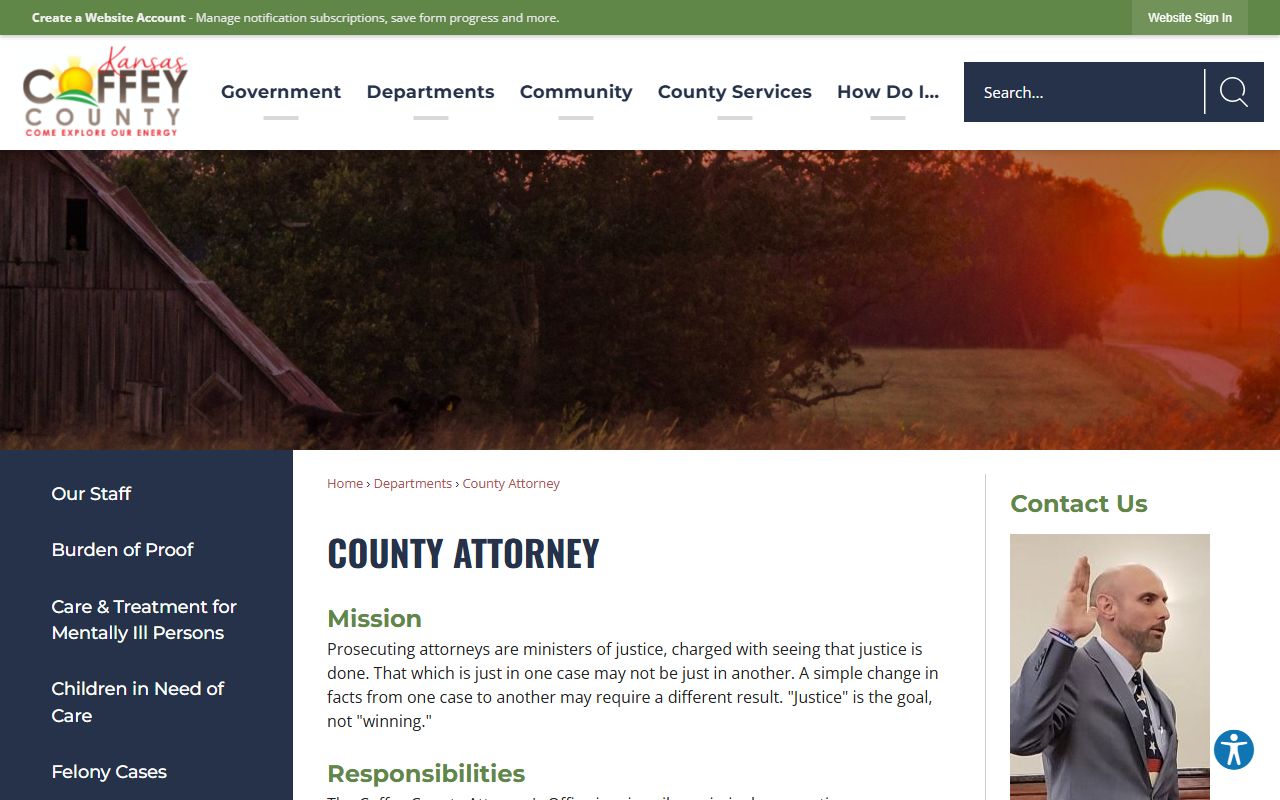
The page is central to criminal court records because it identifies the local office that reviews police reports and prosecutes filed cases.
Search Coffey County Criminal Court Records
Use Kansas District Court CaseSearch for public district court case information and the Fourth Judicial District docket PDFs for current hearing settings. A criminal search can begin with the defendant's name, a case number, or a citation when the case is citation-linked. CaseSearch is the broader case lookup tool, while the docket calendar helps confirm hearing dates, judges, attorneys, and event types.
- Search Kansas District Court CaseSearch by defendant name, case number, business name, or citation if available.
- Confirm the result is tied to Coffey County District Court and the correct case type.
- Review charges, party roles, event history, hearing entries, and disposition information that is public online.
- Check Fourth Judicial District docket PDFs for upcoming Coffey County criminal settings.
- Contact the Clerk of the District Court for certified copies, sealed-entry questions, or cases that are not clear online.
The Clerk of the District Court is at 110 S. 6th, Suite 102, Burlington, KS 66839, phone 620-364-8628. Public hours are Monday through Friday from 8 a.m. to noon and 1 p.m. to 4 p.m. The Fourth Judicial District says public access computers are available at district courts and staff can assist the public with case information.
Coffey County Criminal Case Flow
The County Attorney's felony process describes the local path from investigation to District Court. Law enforcement investigates and files a report with the County Attorney. The prosecutor reviews whether the evidence is sufficient. If a felony charge is filed, the defendant is served by arrest warrant or summons. At first appearance, the court covers the charge, penalties, counsel, next date, and bond. A preliminary hearing may then test whether there is probable cause for the case to continue.
Case flow: Charges Filed › First Appearance › Arraignment › Pretrial and Motions › Plea or Trial › Disposition › Sentencing
| Stage | What Happens in the Record |
|---|---|
| Charges Filed | The prosecutor files a complaint or other charging document that opens the court case. |
| First Appearance | The court addresses the charge, possible penalties, counsel, next setting, and bond. |
| Preliminary Hearing | In a felony case, the court may decide whether probable cause supports further proceedings. |
| Arraignment | The charge is addressed formally and a plea may be entered. |
| Pretrial and Motions | Parties file requests and the judge rules on issues before plea or trial. |
| Disposition and Sentencing | The court records the outcome and any sentence, probation, fine, or follow-up review. |
The Coffey County burden of proof page supports the distinction between accusation and proof in criminal court.
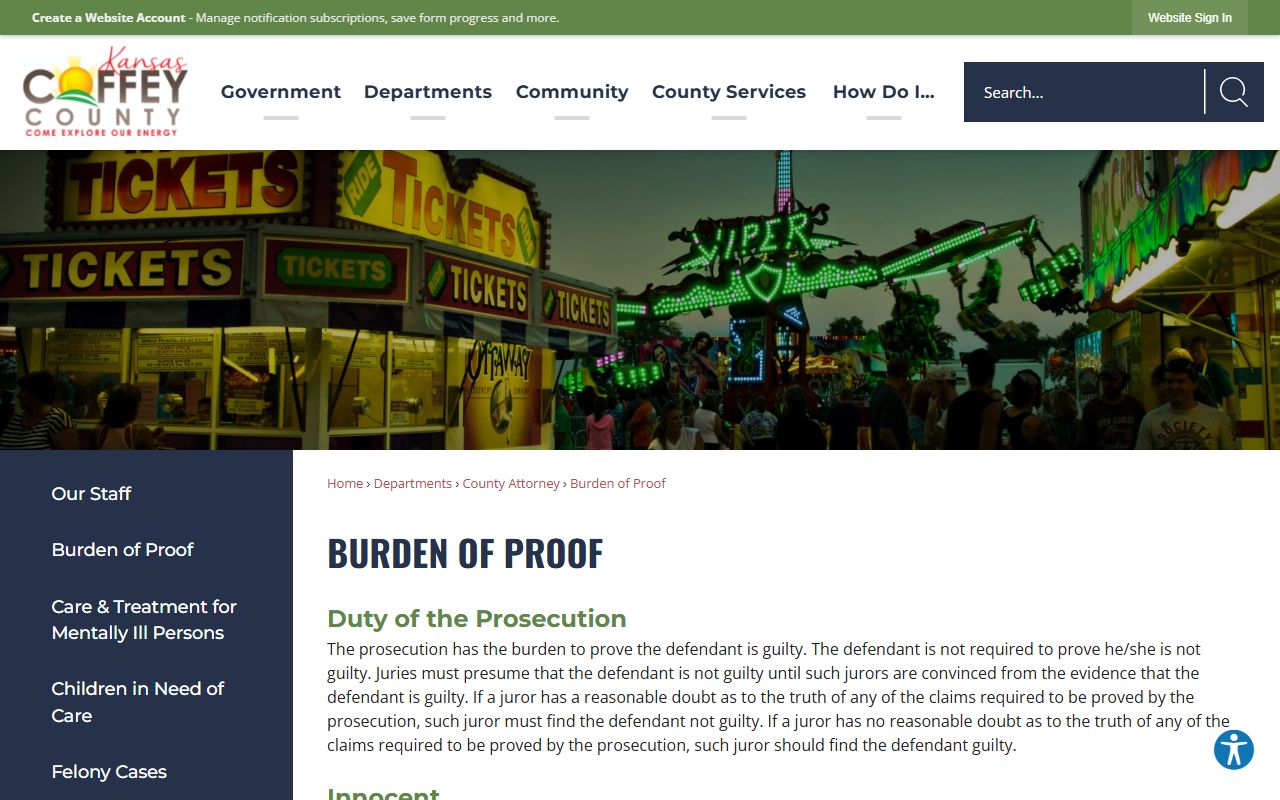
That burden matters because a filed criminal charge is not the same as a conviction in Coffey County District Court.
Coffey County Criminal Record Fields
Criminal court records should be read field by field. A single result may list the State of Kansas as prosecutor, the defendant, the judge, attorney names, charge entries, bond or financial events, hearings, motions, disposition, sentencing, probation violation events, and expungement activity. Docket PDFs show many of these fields, but they do not provide the full pleading file. Certified copies and full document review may require clerk access.
| Field | What It Shows |
|---|---|
| Case Number | A Coffey County criminal identifier, with examples such as CF-2024-CR-000095 in docket research. |
| Caption | The formal case name, often State of Kansas versus the defendant. |
| Defendant | The person accused in the filed criminal case. |
| Prosecutor | The Coffey County Attorney or the State of Kansas Attorney's Office for Coffey County. |
| Charges | The alleged offense or offenses filed after prosecutor review. |
| Bond | Security or conditions tied to appearance, when included in court or custody records. |
| Hearings | Arraignment, motion, status, disposition, review, sentencing, waiver, or expungement settings. |
| Disposition | The outcome of a charge or case, such as plea, dismissal, judgment, or other final action. |
| Sentence | Penalty, probation, jail, fine, costs, or other orders after conviction when shown. |
Coffey County Charges vs Convictions
A charge is an accusation filed in court. A conviction is an outcome after a guilty plea, verdict, or other legally sufficient finding. Coffey County criminal court records can show charges that are later amended, reduced, dismissed, or resolved through a plea. The full Coffey County arrest records and court charges pathway gives closer detail on filed charges, while the criminal case file shows what happened after filing.
| Point | Charge | Conviction |
|---|---|---|
| Meaning | A formal accusation filed by the prosecutor. | A final or qualifying finding after plea, verdict, or judgment. |
| Timing | Near the start of a criminal case. | After court action resolves the charge. |
| Proof Level | Supported by charging standards and probable cause at certain stages. | Requires proof beyond a reasonable doubt or a valid guilty plea. |
| Record Risk | May remain visible even if dismissed unless restricted by law. | May lead to sentence, probation, fines, and later expungement questions. |
Coffey County Prosecutor and Defense
Coffey County uses a County Attorney, not a District Attorney title. Wade H. Bowie II is listed as County Attorney and has held that office since October 2018. The office is in Room 204 of the courthouse at 110 S. 6th Street in Burlington, phone 620-364-5111, fax 620-364-8531, with an alternate phone of 800-947-5124. Office hours are Monday through Friday from 8 a.m. to noon and 1 p.m. to 5 p.m.
The County Attorney's page states that the office cannot provide private legal services to citizens. No Coffey County-specific public defender office was found in official sources. Kansas State Board of Indigents' Defense Services provides defense counsel for people charged with felonies who cannot afford counsel through public defender offices or assigned counsel. For a Coffey County criminal case, the practical route is to request appointed counsel through the District Court at first appearance or through a court-approved application.
The County Attorney child-in-need-of-care page is a source for related prosecutor functions.
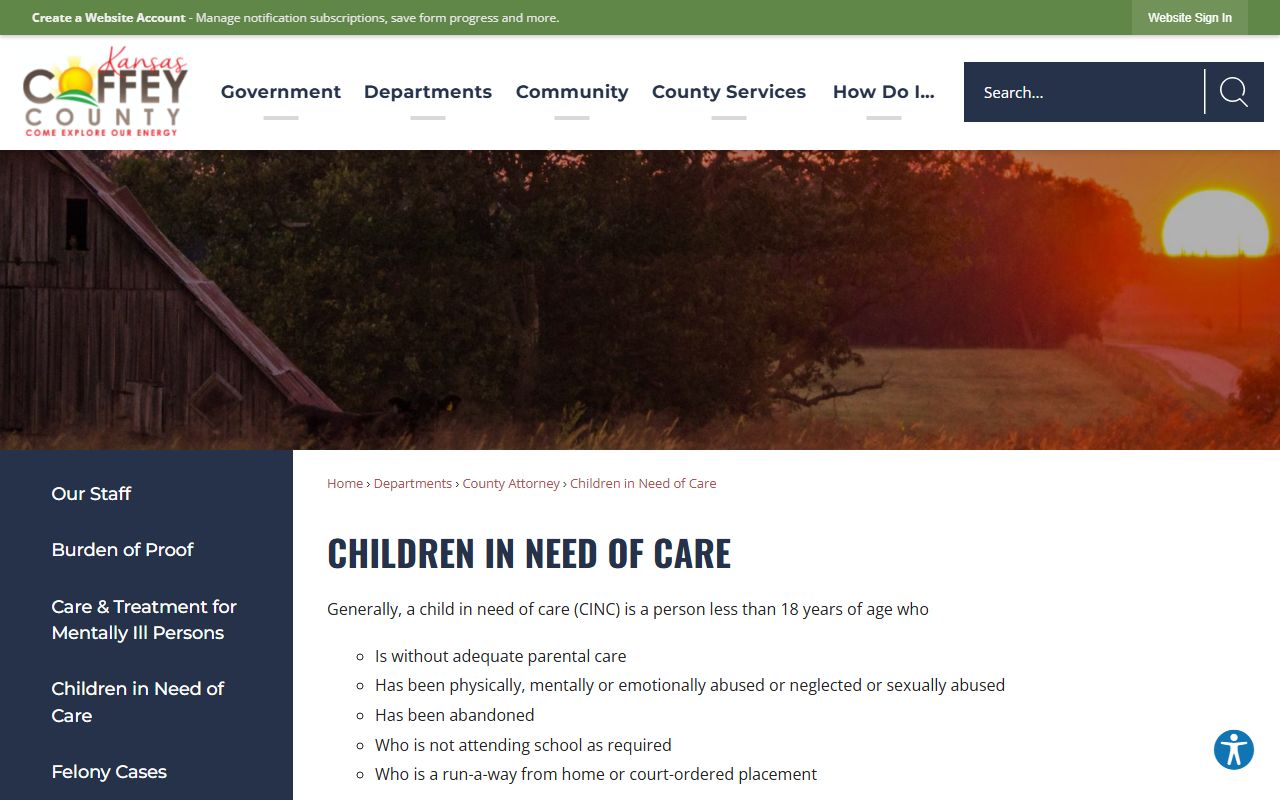
CINC matters are not ordinary adult criminal records, which is why juvenile and child-welfare files need separate access treatment.
The County Attorney care-and-treatment page is another official source for restricted or sensitive prosecution matters.
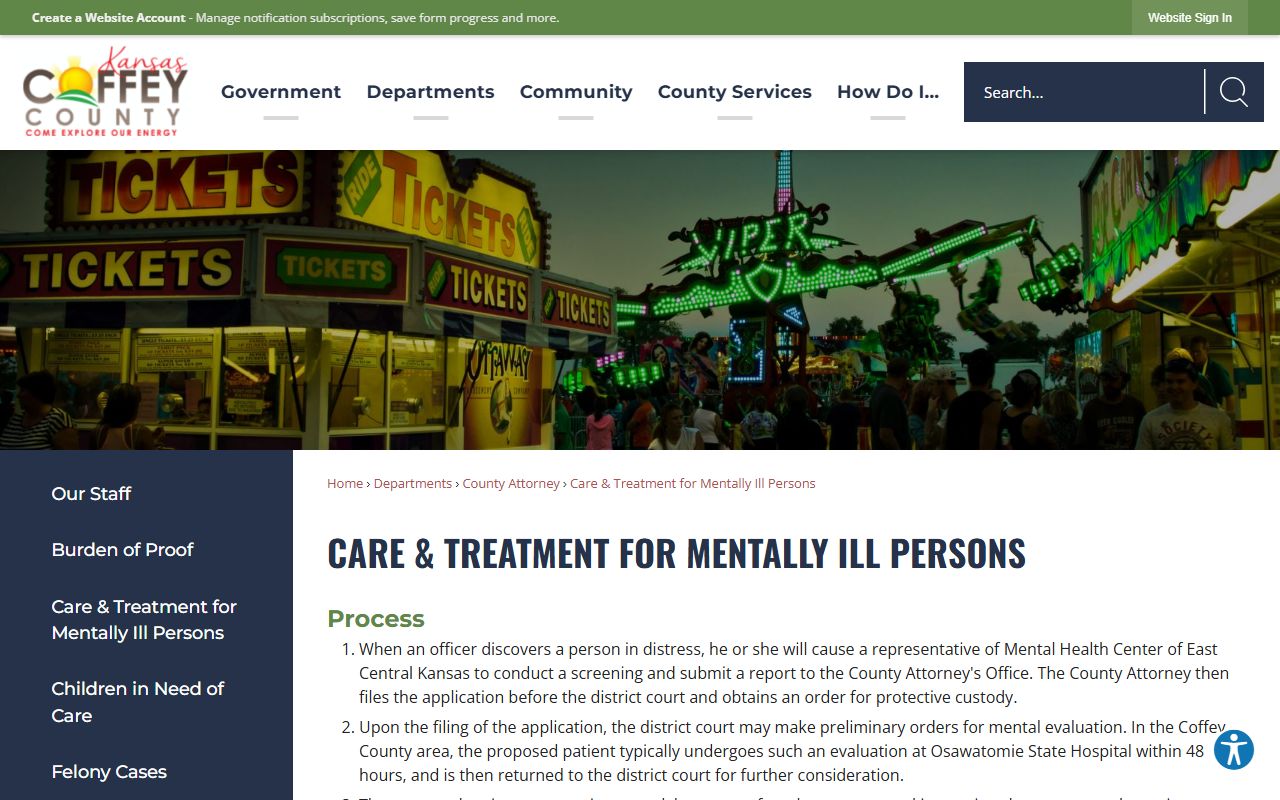
Care-and-treatment proceedings may involve sensitive records and should not be treated as open adult criminal case files.
Coffey County Sealed and Expunged Records
Restricted criminal court records include juvenile records, sealed cases, expunged records, adoption records, and sensitive care-and-treatment or mental health records. Kansas law allows some criminal convictions, arrest records, and diversion agreements to be expunged when statutory conditions are met. The person seeking relief generally files in the court where the arrest, diversion, or conviction occurred. For Coffey County District Court cases, that is the District Court in Burlington.
| Point | Sealed | Expunged |
|---|---|---|
| Public Visibility | Closed from ordinary public inspection by court order or rule. | Public access is restricted after a successful statutory expungement. |
| How It Happens | Often through court order, confidentiality law, or case category. | Usually through a petition under statutes such as K.S.A. 21-6614 or K.S.A. 22-2410. |
| Still Available To | Courts or agencies allowed by law may retain access. | Law enforcement, courts, licensing bodies, or other entities may still access records when Kansas law allows. |
| Common Mistake | Assuming a missing online record never existed. | Assuming expungement physically destroys every government record. |
Note: Court staff can provide forms and filing information, but they cannot give legal advice about expungement eligibility.
Public Access to Coffey County Criminal Records
Adult criminal court records are generally public unless a statute, rule, or court order restricts them. The Kansas Open Records Act supports public inspection of public records, while K.S.A. 45-221 lists exemptions from required disclosure. Kansas Supreme Court Rule 22 controls public electronic access to district court case records, so online availability can differ from courthouse access.
Jail records are separate from criminal court records. The Coffey County Sheriff's roster may show booking number, age, booking date, charges, bond, and a profile link, but the sheriff disclaimer says the Sheriff and Detention Center cannot certify accuracy or authenticity. Bond and charges may change after court appearances, and jail staff should be called for current bail, charges, and case numbers. Custody status is useful, but the District Court file is the source for pleas, dispositions, and sentencing.
The Coffey County Waverly local page provides county-level context for local law enforcement and court access questions.
Local city pages help distinguish municipal contacts from the county District Court record system.
The Gridley public services page also helps distinguish local public safety contacts from District Court records.
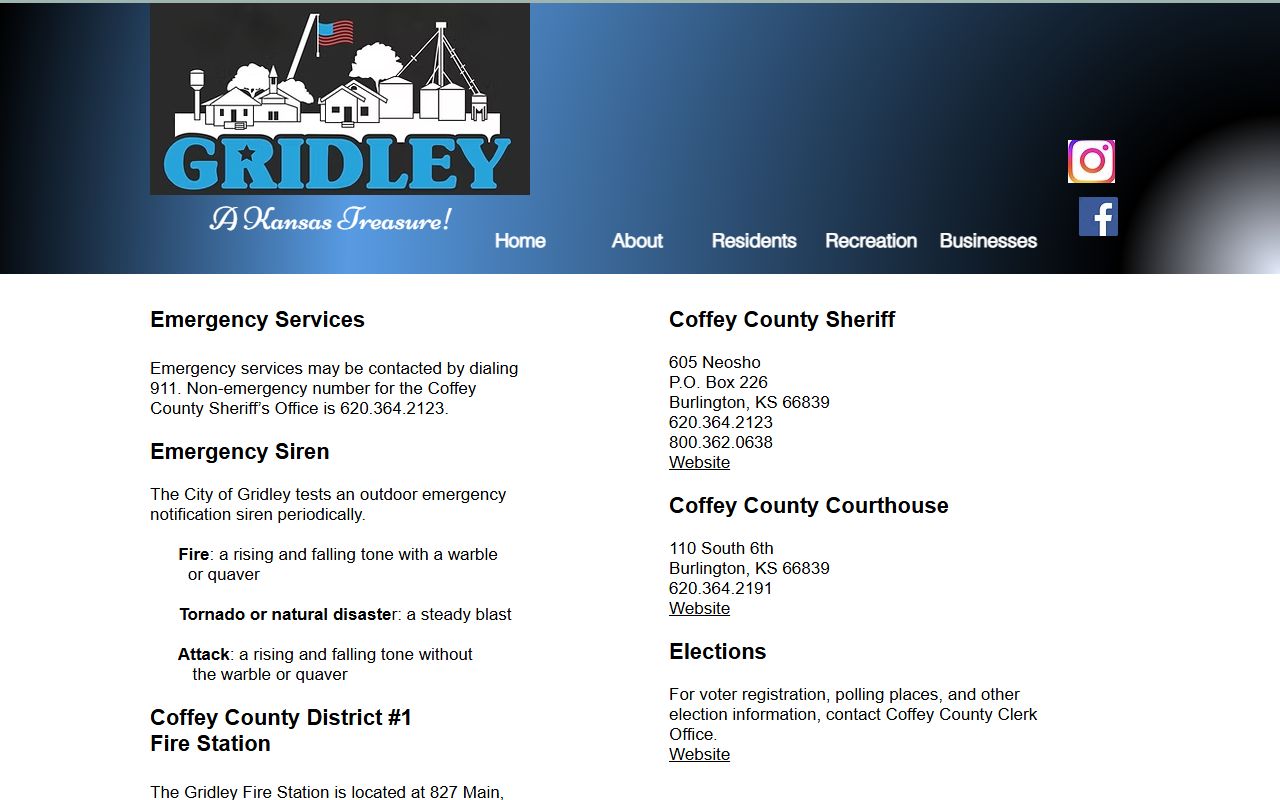
Gridley's public service notes reinforce that local law-enforcement or municipal information is not the same as the filed district criminal case.