
Coffey County Arrest Records and Charges
Coffey County arrest records and court charge records are linked, but they are not the same record. The arrest or booking side may show that a person was taken into custody, the booking number, the arresting agency, the booking date, charges as listed by the jail, bond, and a profile link. The court charge record begins when the County Attorney files a complaint or other charging document in District Court after reviewing the law-enforcement report.
The Coffey County Sheriff's inmate roster can show booking charges, including warrant arrest entries, but the research is clear that it is not a full criminal court case file. The jail roster also carries a warning that charges and bail may change after court appearances. For custody and booking detail, use the jail roster and call jail staff when current bond or charge data is needed. For the filed charge, case status, disposition, or sentence, use District Court records.
Find Coffey County Arrest Records and Charges
Search in two places when an arrest may have led to charges. First, check the Coffey County Sheriff's roster if the question is current custody, booking fields, bond, or whether a person was recently held. Second, use Kansas District Court CaseSearch, Fourth Judicial District dockets, or the Clerk of the District Court to confirm whether the prosecutor filed charges in court. Filed charges and case outcomes belong to the court record.
- Use the sheriff roster for custody, booking number, booking date, bond, and jail-listed charges.
- Search Kansas District Court CaseSearch by defendant name, case number, or citation for filed court charges.
- Check the Fourth Judicial District docket PDF for hearing type, judge, attorney, date, and case number.
- Call the Clerk of the District Court for certified copies or cases that are sealed, unclear, or missing online.
- Call jail staff when bond or custody information may have changed after a court appearance.
The full case history and sentencing detail belongs in Coffey County criminal court records. This arrest-to-charge route focuses on the point where a booking or police report turns into court charges after arrest.
How Coffey County Charges Get Filed
The County Attorney felony process explains the charging decision. Law enforcement investigates and files a report with the County Attorney. The prosecutor reviews whether the evidence is sufficient and decides whether to file a criminal complaint in District Court. If a felony charge is filed, the defendant is served by arrest warrant or summons. The first appearance covers the charge, penalties, right to counsel, next appearance date, and bond. A preliminary hearing may follow in felony cases.
The County Attorney's Office enforces felony, misdemeanor, and traffic laws, plus juvenile, care-and-treatment, asset forfeiture, adult and juvenile matters, and post-conviction matters. The office is led by Wade H. Bowie II and is located in Room 204 of the Coffey County Courthouse. The office cannot provide private legal services to citizens, so questions about defense, plea options, or rights must go through private counsel, appointed counsel, or the court process.
| Document | Filed By | How It Fits Coffey County Charge Records |
|---|---|---|
| Complaint | Prosecutor | The common charging document that starts many Kansas criminal cases after review of a police report. |
| Information | Prosecutor | A formal prosecution pleading used in criminal cases when the prosecutor proceeds without an indictment. |
| Indictment | Grand jury | A grand jury charge document; do not assume every Coffey County felony uses this path. |
Coffey County Charge Status Terms
Charge status can change after the first filing. A case may start with one or more charges, then later show a plea, dismissal, amendment, reduction, probation violation, disposition, or sentencing. A docket entry may show "disposition" without showing every detail of the plea paper or sentencing order. A person checking Coffey County court charges after arrest should follow each charge separately because one charge can be dismissed while another results in conviction.
| Status | What It Means |
|---|---|
| Pending | The charge has been filed and the case has not reached a final outcome. |
| Amended | The filed charge or pleading changed after the original filing. |
| Reduced | The prosecution or court process led to a less serious charge than the original entry. |
| Dismissed | The charge was ended without a conviction on that charge. |
| Disposition | The court recorded a major outcome, such as plea, judgment, dismissal, or other final action. |
| Expungement | A later proceeding may restrict public access if statutory requirements are met. |
The K.S.A. 21-6614 expungement statute is an assigned Coffey County arrest and charge source.
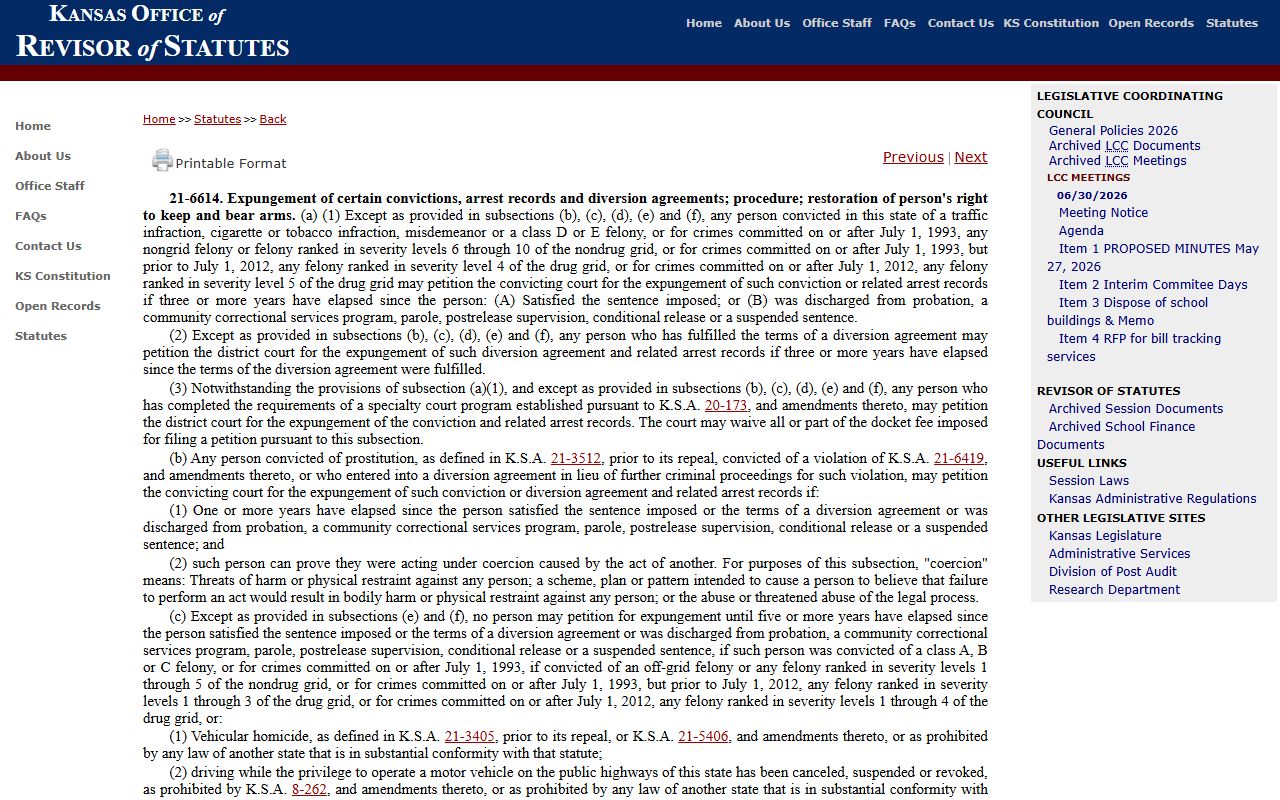
That statute matters because some convictions, arrest records, and diversion agreements may later become restricted by court order.
Coffey County Charges vs Convictions
An arrest record, a filed charge, and a conviction are three different things. An arrest shows that law enforcement took a person into custody. A charge shows that the prosecutor filed an accusation in court. A conviction shows a later legal result, usually after a guilty plea, verdict, or judgment. Coffey County records should be read in that order so an accusation is not mistaken for a final outcome.
| Point | Charge | Conviction |
|---|---|---|
| Record Stage | Filed after prosecutor review. | Entered after plea, verdict, or qualifying judgment. |
| Proof | Not proof of guilt by itself. | Reflects a court outcome meeting the required standard or plea process. |
| Can Change | May be amended, reduced, or dismissed. | May lead to sentencing, probation, appeal, or expungement review. |
| Where to Check | CaseSearch, docket PDFs, and Clerk of the District Court. | Case disposition, judgment, sentencing record, and certified court copy. |
Booking Charges vs Court Charges
The Coffey County Detention page says the jail houses people charged and awaiting trial, people arrested on warrants, people serving county jail sentences, parole or probation holds, people awaiting state prison or Community Corrections placement, people sentenced by municipal courts in Coffey County and elsewhere, and people held for other agencies. That broad custody role means a jail entry may reflect a hold, warrant, sentence, or agency status that is not the same as a new Coffey County District Court charge.
The sheriff roster result fields include inmate name, booking number, age, booking date and time, charges, bond, and a profile link. An inspected profile showed full name, booking number, age, gender, race, arresting agency, booking date and time, charges, and bond. The sheriff warning says bail and charges may change after court appearances, and people posting bail should call Detention Center staff at 620-364-3199 for correct bail amount, charges, and case numbers.
Note: A jail charge label is useful custody data, but the filed court charge controls the criminal case record.
Coffey County Warrants and Arrest Entries
No official Coffey County active-warrant search page was located in the research. The inmate roster may show a booking charge such as arrest by law enforcement or warrant arrest, but that roster is not a complete warrant lookup. District Court bench warrants tied to criminal, traffic, probation, or failure-to-appear matters may appear in case or docket records. Municipal warrant questions may need the municipal court that issued the city citation.
For sheriff questions, the non-emergency number is 620-364-2123, the jail number is 620-364-3199, and records-request questions use 620-364-2282. For District Court case questions, call the Clerk of the District Court at 620-364-8628. Burlington Municipal Court is reached through City Hall at 620-364-5334, with municipal court clerk Lisa Birney listed by the city.
Statewide Charge and History Checks
Statewide tools serve different purposes from Coffey County court charges. The Fourth Judicial District points users to the Kansas Bureau of Investigation for criminal history and registered offender searches, but those are not the same as the District Court case file. KDOC KASPER is for people in KDOC custody or supervision and is updated each working day, excluding weekends. Kansas VINE provides custody notification for county jail offenders, but the Attorney General notes it does not include KDOC offenders housed in state prisons.
The Kansas motor vehicle record limited-search portal is an assigned Coffey County arrest and charge source.
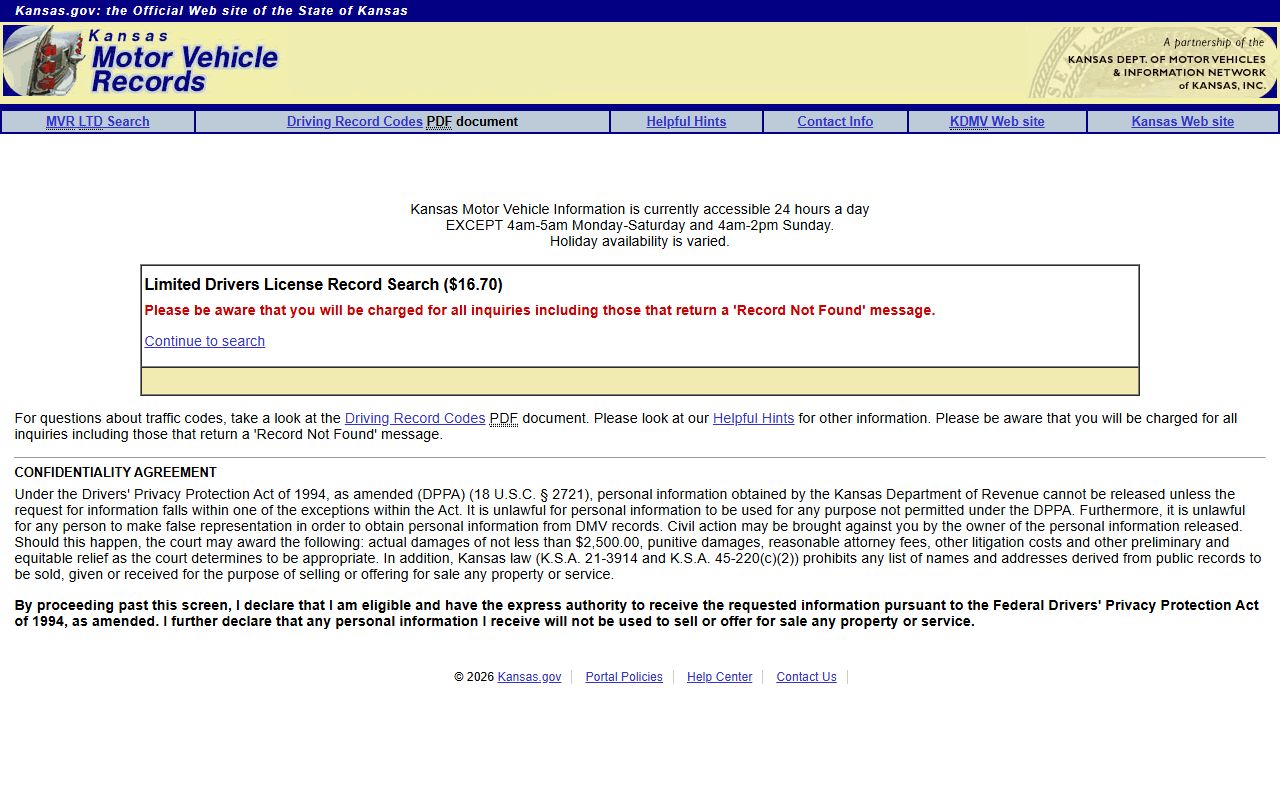
Driving records can relate to traffic enforcement, but they are separate from Coffey County arrest records and filed court charges.
Sealed and Expunged Coffey County Charges
Restricted charge records include juvenile matters, sealed cases, expunged records, and sensitive case categories such as care-and-treatment proceedings. K.S.A. 22-2410 covers expungement of certain arrest records, while K.S.A. 21-6614 covers many conviction, arrest-record, and diversion expungement paths. The person seeking expungement generally files in the court where the arrest, diversion, or conviction occurred.
| Point | Sealed | Expunged |
|---|---|---|
| Public View | Ordinary public inspection is blocked by order, rule, or case category. | Public access is restricted after the court grants statutory relief. |
| Record Status | The record still exists but is closed to most public users. | The record is treated as restricted, but not always physically destroyed. |
| Who May See It | Courts or agencies allowed by law may retain access. | Law enforcement, licensing bodies, courts, or other entities may access it when Kansas law allows. |
| Best Local Office | Clerk of the District Court for filed Coffey County court cases. | Clerk of the District Court for filings and certified order questions. |
The K.S.A. 22-2410 arrest-record expungement statute is another Kansas source for arrest-record limits.
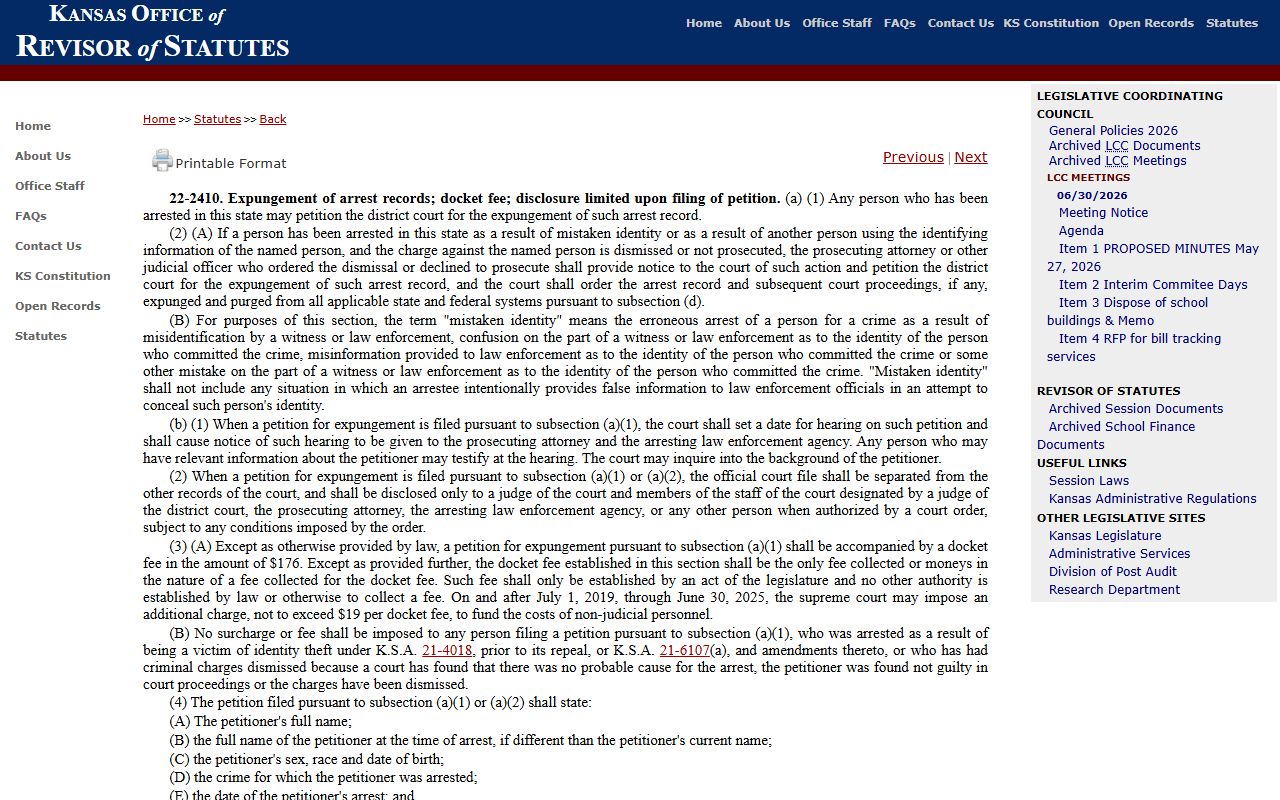
The arrest-record statute is directly relevant when a Coffey County arrest did not lead to the same public result as a conviction.
Public Access to Coffey County Charge Records
Kansas Open Records Act provisions support public access to public records unless a law closes them, but court case access also depends on court rules and clerk procedures. Kansas Supreme Court Rule 22 governs electronic access to district court case records. K.S.A. 45-221 allows exemptions and redactions for information not required to be disclosed. K.S.A. 45-230, cited by the sheriff records-request page, prohibits certain commercial use of names and addresses from public records.
For filed court charges, contact the Clerk of the District Court at 110 S. 6th, Suite 102, Burlington, KS 66839, phone 620-364-8628. For sheriff records requests, use the Sheriff's records process and expect fee authorization by email before fee-bearing requests are completed. For custody, bond, or current charge confirmation after arrest, call the jail at 620-364-3199 because the roster itself warns that charges and bail may change after court appearances.